


In the vast universe of e-commerce, correctly identifying items is a fundamental aspect for keeping track of product movement and ensuring a smooth, satisfying shopping experience.
The product code is a crucial element in this process, since it lets e-commerce retailers:
identify individual products (not product lines, nor brands);
separate the various items present in a marketplace;
keep inventory levels under control;
improve the logistics flow;
offer potential buyers accurate information on individual products.
Keep in mind that, to avoid confusion among the many types of product codes available, you need to be clear about their purpose and when they should be used, so as to avoid duplicates and standardize coding as much as possible.
In this guide, we'll define what a product's identification code is, what it's for, how many types exist, and why you should adopt them to optimize shipping in the marketplace or in e-commerce.
We'll also give you some practical tips on how to use them most effectively.
Click on the titles in the list below to read directly the content that interests you.
What is a product's identification code?
What product coding is for and what benefits it gives
Types of identification codes and how to get them
How to use product codes effectively
Optimize all your key processes with Sendcloud
What is a product's identification code?
The product code is a unique system of numbers or letters that is assigned to a given item.
The main benefit of coding your goods in a systematic way is being able to track every single item at every stage of the supply chain, thus determining:
the quantity available in stock,
the progress of the product's shipment,
greater control over delivery times.
But this doesn't only let you monitor every movement better. It also ensures greater transparency toward the consumer and helps protect the business and users in the event of a product recall (or any counterfeiting).
On the market there are several types of identification codes, each of which has a specific use and can be used for different purposes, like inventory management, logistics tracking, or listing goods on marketplaces.
As the owner of an online shop, you can use these standard identifiers to assign each item a unique code that differentiates it from every other one in the world.
What product coding is for and what benefits it gives

As we've already mentioned, assigning an identification code to each product is a step of great importance for online stores.
Here are the main benefits of adopting this methodology.
1. Inventory management
First of all, the identification code serves as a mechanism to distinguish and uniquely identify every item in stock.
Thanks to unique alphanumeric codes, you keep track of the quantities available and manage your stock in the best way.
With identification codes correctly assigned and used, you can track the quantities of available products, their movement within the warehouse, and the sales made.
This information lets you better manage warehouse stock, plan restocking, and improve e-commerce logistics, minimizing operational disruptions and ensuring product availability.
2. Order-processing speed
Using precise, accurate identification codes simplifies the order-processing process, reducing errors and speeding up shipping.
This aspect is particularly crucial if you work with perishable goods like food, or if you handle large quantities of products and need to avoid confusion and traceability problems.
3. Improving the customer experience
Another important benefit of the identification code is its ability to provide detailed information about the products in the catalog.
This is particularly useful for consumers who want to know the features, dimensions, materials, and other specific information about a product.
With the correct identification code, users can quickly access this information, make informed purchase decisions, and reduce the likelihood of returns or post-purchase disappointment.
All this can increase customer trust and satisfaction over time.
4. Integration with marketplaces
Many marketplaces require the use of standard codes to list products online.
Adopting compliant codes simplifies expanding your business and makes it easier to automate and integrate business processes, helping you connect with trading partners, suppliers, and marketplaces more simply and efficiently.
For example, when selling products on platforms like Amazon or eBay, identification codes like the ASIN (Amazon Standard Identification Number) are central to correctly listing and cataloging goods.
Discover how to automate your Amazon Shipping shipments with Sendcloud
Types of identification codes and how to get them

There are several types of product identification codes, each with a specific purpose and widely used in the e-commerce sector. Here's an overview of the most common ones:
Global Trade Item Number (GTIN)
The Global Trade Item Number (GTIN) is a code used worldwide to uniquely identify products and services in the supply chain, during pricing, ordering, or invoicing operations.
This coding system was developed by the non-profit association GS1 (Global Standards One), which works to ensure global standards in business communication.
The GTIN includes several standard, universal identification codes that are essential for anyone who decides to ship abroad.
Among the most important, we can mention:
International Standard Book Number (ISBN) for books;
International Standard Serial Number (ISSN) for serially published products like magazines and periodicals;
International Standard Music Number (ISMN) for musical scores;
International Article Number (EAN and JAN) for physical products;
Universal Product Code (UPC), a type of barcode widely used in America and other regions.
Although most products in the world use codes that fall within the GTIN system, in e-commerce there are also other codes specific to certain platforms.
For example, the MPN is commonly used on AliExpress and eBay to sell parts and components of items, while the ASIN (which we'll see later) is used by Amazon to identify specific goods.
Universal Product Code (UPC)
It's a barcode system that is part of the GTIN system and is widely used in areas like:
Canada,
the United States,
New Zealand,
Australia.
This 12-digit coding uniquely identifies a specific product and can be scanned or typed in at the time of purchase to find the product's basic information like the name, brand, and price.
The UPC code is recognized internationally and can be used for selling retail products across various channels and for retailers who want to ship to America.
The goal of the UPC barcode is to easily determine not only individual items but also their characteristics. A manufacturer, in fact, can require that the variants of a given item each have their own code.
If you want to get the UPC for your products, you just need to request registration with GS1 and buy a block of codes, which will be assigned to you for exclusive use in your e-commerce. You can then use it to label your goods and manage inventory.
European Article Number (EAN)
Similar to the UPC code, the EAN code is mainly used in Europe and it too includes a GTIN code as part of GS1.
It's a barcode of 12-13 numbers that uniquely identifies a product and can be read by a computer to manage inventory, process movements, and track physical products sold in Europe.
Italian online stores and marketplaces that offer international shipping within the EU can, thanks to the EAN, request unique figures to identify different colors or styles of their products.
As with the UPC, the EAN code too can be obtained through an online process by contacting the GS1 organization in our country.
Stock Keeping Unit (SKU)
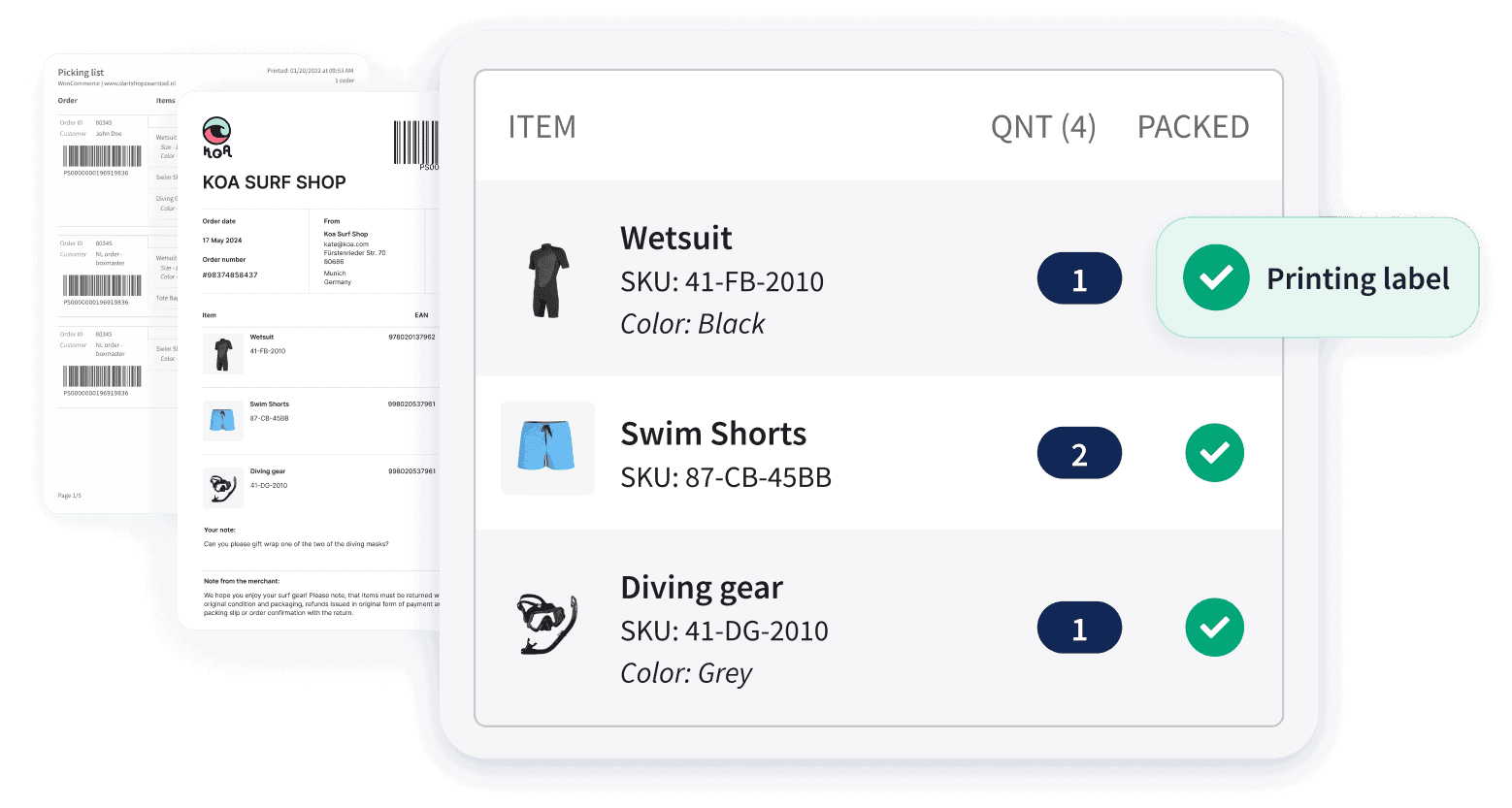
The SKU code is an alphanumeric set used internally by companies to identify "stock keeping units", that is, specific individual products.
SKUs can vary from one company to another and are generally found on item labels, in the product pages of e-commerce sites, and in internal inventory management systems.
The purpose of the SKU is to simplify the internal workflow, that is:
help customers find catalog goods more easily;
monitor order status;
automate communication with suppliers and staff;
manage stock;
organize the warehouse by expiry date or product type.
You can create SKU codes internally through your e-commerce management system. Just make sure to use a consistent, well-structured system to ensure the uniqueness of the SKU codes and simplify the work.
For example, you can integrate your shop with the shipping platform Sendcloud. It will let you create your shipping rules simply and quickly, also automating the label-creation process.
Amazon Standard Identification Number (ASIN)
If you want to sell your brand's items on Amazon, you'll need to create ASINs, that is, unique codes assigned to private-label products for sale in Amazon's catalog.
Keep in mind, though, that:
you must create new ASIN codes: only if you sell your own branded product line on Amazon Seller Central or if you have exclusive distribution rights for a product.
You must look for an ASIN already present in Amazon Seller Central: if you resell branded items already present on the platform (for example, Adidas shoes). In this case, you'll have to look up the code and create an offer with that ASIN.
The ASIN code is particularly important for sellers who use Amazon as their main sales channel because it lets them track sales on the platform.
You don't need to get an ASIN code in advance, but it's important that you provide accurate, detailed information about your products during the Amazon listing process.
International Standard Book Number (ISBN)
The ISBN is used instead of the UPC for marketing books and is part of the GTIN system.
Books published after 2007 usually have a 13-digit ISBN code, which represents the most common structure of the codes assigned by GS1.
Every edition of a book has a unique ISBN, so new editions receive a new number.
Note that if you aren't a publisher but only resell third-party publishers' books online, you don't need to create an ISBN.
You can simply enter the ISBN of the books you intend to sell on platforms like Amazon, eBay, and other marketplaces.
Manufacturer Part Number (MPN)
The Manufacturer Part Number is essential for reselling car parts, vacuum-cleaner components, appliance parts, food processors, and more.
Customers need the correct MPN code to be sure they're buying the right spare part, piece, or accessory for a given item.
Users usually check this code several times before making a purchase and enter it directly into sites' search bars to get relevant results.
Usually, using an MPN becomes necessary when the manufacturer hasn't already assigned a GTIN code like a UPC or an EAN.
However, if a product has both codes, it's advisable to include them all in the product page to give buyers more confidence.
If you produce spare parts and components, we suggest getting a GTIN (UPC or EAN, depending on where you are) and adding it to your digital store and marketplace listings.
How to use product identification codes effectively
Some useful tips to get the most out of using a product code.
Assign unique codes: make sure every item has a unique identification figure. This will avoid confusion and inventory-management problems.
Use recognized standards: adopt at least one internationally recognized standard identification code, like UPC and EAN. This will let you easily connect with other retailers and marketplaces.
Label products correctly: apply the codes clearly and legibly on the packaging. Use technologies like barcodes or QR codes to simplify scanning and tracking. Also, by investing in a branded tracking system you communicate in real time with your customers, increasing loyalty and repeat purchases.
Integrate the system with your business management software: an integrated solution is essential to connect inventory, logistics, and coding. Sendcloud lets you keep track of shipping data, incoming and outgoing, making restocking operations easier and maximizing the workflow.
Optimize product descriptions: use codes to enrich descriptions online and on packaging. Include scannable information, like weight, dimensions, or other specific features. This will help customers better understand the specs and make more informed decisions.
Monitor results: start monitoring your items' performance by integrating the codes and your WMS software with Sendcloud. You'll be able to analyze sales, views, and other important KPIs. This will let you recognize successful products and adopt targeted marketing strategies.
Leverage automation: there are tools and technologies that can simplify the use of identification codes. Sendcloud helps you generate unique codes, integrate inventory and shipments, and automate the labeling process by creating paperless labels. These solutions save you time and minimize manual errors.
Keep your codes updated: when you make changes to individual products or entire lines (adding new packaging or a specs upgrade), make sure to also update the corresponding codes. This will avoid confusion and potential problems in the warehouse and in communication with customers.
Optimize all your key processes with Sendcloud
Identification codes are essential elements for ensuring your business's success, since they let you oversee sales and ensure your brand's integrity.
After a customer has placed an order, it becomes crucial to manage the shipment quickly and accurately.
To meet buyers' expectations, you need to offer solutions like:
several multi-carrier shipping options,
an automated order-tracking service,
constant updates on shipment status,
making online returns easier.
Sendcloud is the perfect option for managing all these operations from a single interface.
The platform integrates perfectly with your store and all carriers, letting you oversee every aspect of your shipments (domestic and international) efficiently.
All without needing to develop custom software.
Optimize your e-commerce logistics with Sendcloud
Sign up for free in a few minutes and discover all the benefits of integrating with Sendcloud.

Author and researcher
How much time can you save on shipping?

Share
Recommended for you

Shipping Intelligence
Shipping
E-commerce
Best 9 Shipping Data Analytics Software Tools (2026)
E-commerce
Enterprise
The true cost of post-purchase: what e-commerce shipping really costs enterprise retailers

Shipping to a parcel locker: all the benefits and options
Adding parcel lockers to your shipping options is a smart move. Want to know why? Read our article to discover all the benefits.