


Shipping to the Canary Islands is a key step in growing your online store. Understanding the whole process is crucial, since it involves more than delivering to another region of Spain — check out our guide to ecommerce logistics for the fundamentals.
Last year, 873,000 Canary Islands residents made at least one online purchase, according to data from Canary Islands logistics company e-log. Ecommerce revenue in the archipelago also grew by 66%. Even so, the number of online shoppers there still lags behind the national average.
That's largely because many online stores don't offer shipping to the Canary Islands at all. Why? Shipping costs, customs paperwork, and taxes are the main reasons sellers hold back.
Expanding your delivery area to include the Canary Islands can help your store stand out from the competition and keep growing.
Why shipping to the Canary Islands is different from shipping to mainland Spain and the EU

The first question to answer is: why is shipping to the Canary Islands different from shipping to the rest of Spain and other EU countries?
The Canary Islands have a distinct tax regime, since the archipelago is geographically separate from mainland Europe. That means every shipment to the islands has to go through customs procedures.
Although the Canary Islands are part of the EU, they're exempt from VAT. Instead, two local taxes apply: the General Indirect Tax of the Canary Islands (IGIC) and the Canary Islands Tax on Imports and Deliveries of Goods (AIEM).
What is IGIC?
IGIC works as the Canary Islands' equivalent of VAT. The rate depends on the type of product.
For example, here's the IGIC rate applied to some common product categories:
Perfumes and extracts: 13.5%
Toilet waters and eau de perfume: 3%
Soaps and bath gel: 3%
Bags, wallets, and suitcases: 3%
Sports goods: 3% to 7%
Footwear: 3%
The Chamber of Commerce of Santa Cruz de Tenerife has published a table listing the most commonly imported products and their applicable IGIC rate. You can check it at this link (Spanish).
What is AIEM?
AIEM, meanwhile, is a tariff charged on goods entering the Canary Islands. Rates range from 5% to 25%, depending on the product.
For example, here's the AIEM rate applied to some items:
Fresh grape wine: 5%
Synthetic-fiber swimwear: 5%
Paper tablecloths and napkins: 15%
Artist's paint colors: 5%
Roasted coffee (non-decaffeinated): 15%
Roasted decaffeinated coffee: 5%
You can find the full list of products and their AIEM rate at this link (Spanish).
Keep in mind that IGIC and AIEM for shipments to the Canary Islands are settled through the Single Administrative Document (SAD) at customs.
What about shipments to Ceuta and Melilla?
Ceuta and Melilla are in a similar situation to the Canary Islands.
Like the Canary Islands, they fall outside the EU's customs territory, so shipments there are also exempt from VAT.
Instead, the Tax on Production, Services, and Imports (IPSI) applies, at rates ranging from 0.5% to 10%, depending on the goods.
Here's the IPSI rate for some example products:
Unsweetened cocoa powder: 0.5%
Fresh grape wine: 0.5%
Knitted shirts and T-shirts: 10%
Footwear: 7%
Wristwatches, pocket watches, and similar: 10%
Eyeglass frames: 10%
Check this link (Spanish) to find the rate that applies to the products you sell.
Customs documents for your Canary Islands shipments

To make sure your Canary Islands shipments go smoothly, you need to know exactly which customs documents to attach to each parcel. Otherwise, your package is likely to arrive late or get returned.
Here are the documents you need to submit to customs along with your Canary Islands shipment:
1. Commercial invoice without VAT, stamped and signed. This is required for shipments between mainland Spain and the Canary Islands, in either direction. It should include:
Number of packages
Unit and total value of the items
Exporter and importer details, including both parties' tax ID (NIF)
Product description
Payment terms
Invoice number
Shipping terms
Incoterms
EORI number (a unique code used to track and register customs information within the EU — read our guide to the EORI number to learn more)
If you ship to the Canary Islands with Correos, you'll also need to fill in a CN22 form for shipments valued under €22 that weigh no more than 2kg. For shipments above that value or weight, you'll need a CN23 form instead. You can fill in and print both directly from your Sendcloud account.
Remember to attach three copies of the CN23 and of the commercial invoice when shipping to the archipelago. You don't need a separate CN22 for Canary Islands shipments — it's already built into the shipping label.
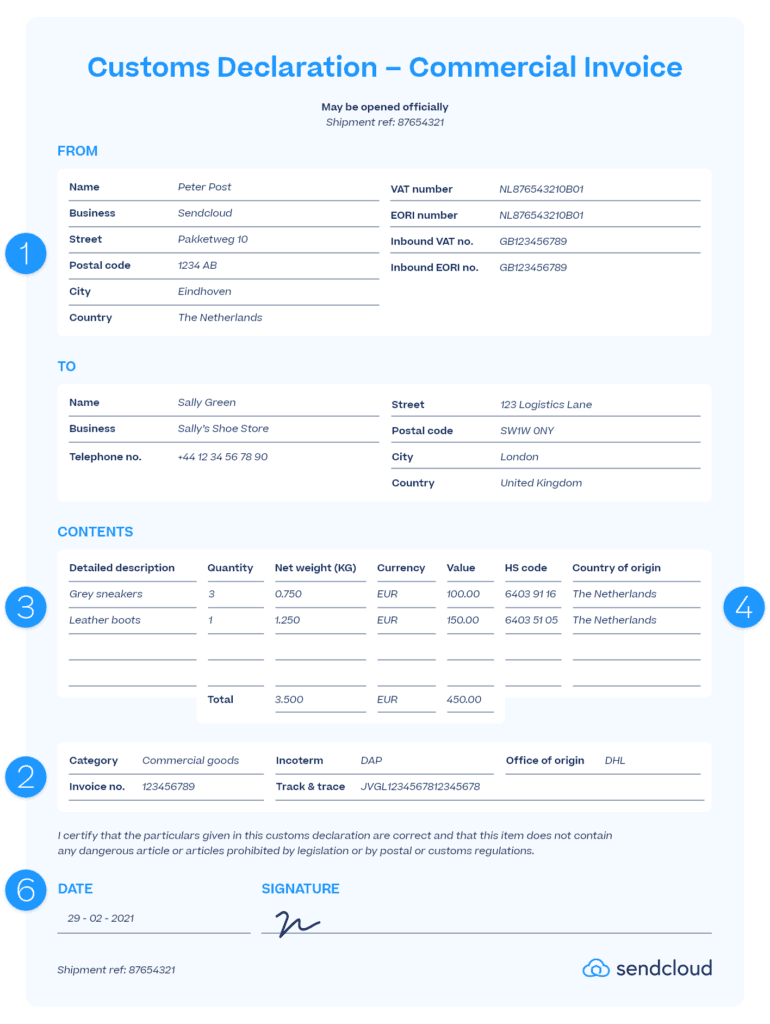
This is an example of an unofficial commercial invoice. The layout may vary, but the required information stays the same. Make sure to fill it in in English.
We've written a full guide covering everything you need to know about CN22 and CN23 customs forms.
2. Single Administrative Document (SAD). This covers the import duties owed — IGIC and AIEM for shipments from the mainland to the Canary Islands, and VAT for shipments from the Canary Islands to the mainland.
The SAD is submitted electronically, and three copies are required. If you use a customs agent — typically your carrier — to file it for you, you need to state this explicitly on the document.
3. Customs broker authorization form. Your carrier provides this so they can handle all the customs procedures for your Canary Islands shipment. For reference, here are the authorization templates from Correos, SEUR, Correos Express, and MRW.
UPS and DHL Express both offer a "paperless" system, meaning these forms are submitted digitally to the carrier — saving time and hassle.
MRW, SEUR, UPS, and DHL Express all charge an extra fee for handling customs clearance.
Taxes to pay when shipping packages to the Canary Islands
As mentioned, shipments to the Canary Islands are treated fiscally as exports. That means items sold from the mainland to the Canary Islands are VAT-exempt.
Your customers in the Canary Islands are responsible for paying IGIC. The amount owed is separate from the carrier's shipping costs.
In general, imported products are subject to a generic classification (Spanish): a 2.5% tariff, 7% IGIC, and 21% VAT. If the tariff classification of the items is specified instead, customs won't apply this generic rate. This percentage is calculated on the shipment's value, excluding shipping and insurance costs.
Previously, purchases of €22 or less were exempt from tariffs and VAT. Under the new EU ecommerce VAT rules, customers shipping within the EU now have to pay VAT even on purchases at or below that threshold.
For shipments valued between €22 and €150, the purchase is exempt from tariffs, but VAT still applies.
For shipments valued above €150, a 2.5% tariff and 21% VAT both apply.
This only applies to universal postal service providers like Correos. Private carriers apply these thresholds differently — Correos Express, for example, applies them starting from €0.01.
That said, if your customers pay with all costs and taxes included — known as DDP (Delivered Duty Paid) — they'll receive their order at home with no extra charges.
If you have a Sendcloud account and use your own carrier rates, you'll need to arrange this directly with your carrier's account manager, whether that's Correos, Correos Express, DHL Express, or another provider.
With that option, you as the seller take on all customs costs yourself. In that case, you'll need to include the delivery address on the invoice.
Correos vs. private carriers
Before choosing a carrier for your Canary Islands shipments, it's worth understanding the difference between Correos and private carriers.
Correos is a universal postal service, so its rates tend to be more affordable than those of other carriers. Taxes on your Canary Islands shipments can also vary depending on whether you use a private carrier.

Incoterms for shipping to the Canary Islands
Using Incoterms 2020 for shipments to the Canary Islands isn't mandatory, since they're voluntary.
Even so, using them for your archipelago shipments helps clarify your obligations as a seller.
For example, you could ship under DDP, covering all costs yourself, or under DAP, where your customer takes on clearance, tariffs, and taxes — always based on the total shipment value, as explained above. If you're using our carrier rates, this is generally how your Canary Islands shipments will be handled.
Choose the best carriers for shipping to the Canary Islands
Before you start shipping to the Canary Islands, it helps to know which carriers you can rely on. Understanding their shipping methods, delivery times, and benefits will help you streamline the process.
Since shipping to the Canary Islands can be a bit more complex than shipping to the rest of mainland Spain, we've put together a list of the best carriers. Just pick the ones that fit your ecommerce's needs.
These are some of the carriers that ship to the Canary Islands:
Correos
Correos Express
SEUR
MRW
UPS
DHL Express
Let's look at the shipping methods and delivery times each carrier offers. Note that several of these services are also available if you want to ship from the Canary Islands to mainland Spain.
Shipping to the Canary Islands with Correos

1. Paq Premium
Personalized delivery service — your customer chooses when and where to receive their order.
Delivery to the Canary Islands takes 3 business days.
Includes the option to schedule a delivery date and/or time slot.
2. Paq Estándar
The more affordable option for non-urgent shipments.
Packages take 6 to 8 business days to arrive when shipped from mainland Spain.
If both origin and destination are within the Canary Islands, delivery takes 3 to 4 business days.
Keep in mind that none of these Correos delivery times include customs clearance, so packages can take longer to arrive than stated.
If you have your own contract with Correos and want them to act as your indirect customs representative, you'll need to download their authorization form.
Shipping to the Canary Islands with Correos Express

1. Canarias Express
Express delivery service for your Canary Islands shipments.
Delivery to Gran Canaria and Tenerife takes 1 business day.
Packages to the rest of the Canary Islands arrive within 2 business days.
Shipping to the Canary Islands with SEUR

1. Canarias aéreo (air freight)
Use this service for urgent shipments to the Canary Islands.
Delivery takes 2 to 3 business days.
2. Shipments between the Canary Islands and the Balearic Islands
Use this express delivery service to ship between the Canary Islands and the Balearic Islands.
Delivery takes 2 business days.
Shipping to the Canary Islands with MRW

1. Economy
Best suited for shipments that aren't especially urgent.
Delivery to the Canary Islands takes 1 to 3 business days.
MRW provides customs authorization templates to help speed up the process for your Canary Islands shipments.
UPS: how to ship to the Canary Islands

1. UPS Standard
An economical delivery service for less urgent packages.
Delivery time depends on the pickup date.
The package is delivered sometime during the day.
2. UPS Express
An express delivery service for shipping to the Canary Islands.
Delivery takes 1 business day.
Your customer receives their package before 10:30 a.m. or noon.
3. UPS Express Saver
An economical express delivery service.
Delivery takes 1 business day.
UPS delivers the package sometime during the day.
Alongside these delivery options, UPS also offers a customs clearance service that processes shipments almost immediately.
Managing shipments to the Canary Islands with DHL Express

1. Same Day
An urgent delivery service where DHL Express handles the entire process, from pickup to delivery.
The package is delivered in the shortest time possible.
2. Time Definite service
A fast shipping service with a guaranteed delivery time.
Delivery takes 1 business day if origin and destination are within the same zone.
For shipments originating outside the Canary Islands, delivery takes 2 business days.
Keep in mind that shipping to the Canary Islands with UPS or DHL Express comes with an additional surcharge.
How long does it take for a package to arrive in the Canary Islands?
Your customers will likely ask how long their package will take to arrive. If you have a Sendcloud account and use these shipping methods, here's what to expect.
Carrier | Shipping method | Feature | Delivery time |
|---|---|---|---|
Correos | Paq Premium | Personalized delivery — customer chooses date and time | 3 business days |
Paq Estándar | More affordable option | 3 to 4 business days | |
Correos Express | Canarias Express | Express service | 1 business day to Gran Canaria and Tenerife |
2 business days to the rest of the islands | |||
SEUR | Canarias aéreo | Express service | 2 to 3 business days |
Canary Islands–Balearic Islands | Express service between the Canary Islands and the Balearic Islands | 2 business days | |
MRW | Economy | Non-urgent deliveries | 1 to 3 business days |
UPS | UPS Standard | Affordable for less urgent packages | Depends on pickup date; delivered during the day |
UPS Express | Express service | 1 business day | |
UPS Express Saver | Affordable express service | 1 business day | |
DHL Express | Same Day | Urgent service, pickup and delivery | Next day, in the shortest time possible |
Time Definite service | Guaranteed delivery time | 1 business day within the islands | |
2 business days with origin outside the islands |
Is there an express shipping method for the Canary Islands?
Yes. You can also get shipments to the Canary Islands delivered quickly using:
Correos Express's Canarias Express, but only if the destination is Gran Canaria or Tenerife
MRW's Express service
UPS Express and UPS Express Saver from UPS
DHL Express's Same Day service
Returns on shipments to the Canary Islands
When shipping to the Canary Islands, keep in mind that some items will end up being returned. To make sure returns don't become a growth blocker, it's worth understanding how returns from the Canary Islands work.
As covered above, shipping to the Canary Islands is simpler than it might seem — and the same goes for returns. The process largely depends on which carrier you choose to handle it.
In general, you'll be the one covering return shipping costs. That said, offering free returns tends to pay off, since customers are more likely to buy from your store when they know returns won't cost them anything.
Ship to the Canary Islands with one click using Sendcloud

Manage your ecommerce shipments to the Canary Islands with a single click, thanks to Sendcloud.
Our software lets you ship between the Canary Islands and mainland Spain hassle-free, automating the entire process.
When shipping to the Canary Islands with Correos, DHL Express, or UPS, you can print all the customs documents you need together with your shipping labels straight from your Sendcloud account. That way, you can be sure your package arrives within the agreed timeframe and your customer gets a great delivery experience.
You can also set up shipping rules for packages heading to the archipelago, so every Canary Islands shipment automatically goes out with the best carrier for the job, based on the parcel's details and final destination.
All you need to do is connect your online store to Sendcloud and set up your account.
Save time and money on your Canary Islands shipments with Sendcloud
Shipping to the Canary Islands with sendcloud.proes with several benefits. Here are just a few ways your ecommerce business can benefit:
Ship more affordably to the Canary Islands by optimizing your online store's checkout.
Handle more orders in less time, freeing up hours you can spend growing your business instead.
Get better visibility over your ecommerce logistics.
Simplify your returns process and turn it into an advantage for your store.
Send personalized tracking notifications to keep customers confident in your brand.
Print multiple shipping labels with one click, speeding up your workflow and reducing errors thanks to automated logistics.
Set up your Sendcloud account in under 5 minutes and start taking advantage of everything our software offers. Prefer to have one of our experts walk you through the platform first? Book a free demo.
Have any questions about how Sendcloud can help with your Canary Islands shipments? Leave a comment below — we'll get back to you as soon as possible!


Author and researcher
Marina Fernández leads the Communications craft, creating e-commerce, B2B, and SaaS content. She ensures that every piece of content is of the highest quality and effectively meets its intended purpose.
How much time can you save on shipping?

Share
Recommended for you

Shipping
Integrations
Best Shopify shipping apps: compare features, pricing & automation
Compare the best Shopify shipping apps for automation, carriers, labels, tracking, returns and international shipping. Find the right app for your store.

Shipping
Shopify shipping automation: How to automate your fulfillment workflow
Learn how Shopify shipping automation helps you automate fulfillment workflows, reduce shipping errors, save time, and scale with Sendcloud.

Shipping Intelligence
Shipping
E-commerce