


Managing e-commerce shipping is a crucial challenge for selling online successfully.
According to one study, the global value of e-commerce shipping will reach a record 557 billion euros by 2025, but 54% of European companies that sell online say their sales potential is limited or heavily impacted by their logistics capabilities.
To optimize the delivery process, companies need to focus on efficiency, sustainability, and shipping automation, developing an effective delivery strategy that reaches customers quickly and smoothly.
In this article, we'll take a detailed look at how e-commerce shipping works, helping you optimize your store's logistics operations.
How e-commerce shipping works
How to manage e-commerce shipping and reduce costs
How to choose the most suitable e-commerce carrier
Domestic and international shipping: how to optimize them
Automation: the solution to optimize every shipment
How e-commerce shipping works
E-commerce logistics is radically different from traditional logistics. To understand how e-commerce shipping works, let's look at the most relevant differences.
Traditional logistics concerns B2B or large-retail activities, and involves generally large and regular exchanges of goods, with a flow and demand that are planned in advance and stay constant throughout the year.
E-commerce logistics, on the other hand, mainly concerns the B2C segment and is more fragmented than classic logistics.
Shipments can happen through different touch-points (online store, marketplace, physical store, etc.), involve a larger and more frequent flow, and are influenced by seasonality and promotional periods (like Black Friday).
In addition, returns management takes center stage and becomes an integral part of the shipping procedure.
How to manage e-commerce shipping and reduce costs
Rising shipping costs risk eating into the profits of companies that sell online, with a significant impact on long-term operations.
The statistics leave no room for doubt: from March 2020 to today, the cost of shipping a container by sea has grown sevenfold.
And for road or air shipments too, rising fuel prices are sending costs sky-high.
In other words, managing e-commerce shipping more effectively and reducing costs is something that can't be overlooked.

How to reduce shipping costs
Here are some tips to manage e-commerce shipping efficiently and cut costs.
Optimize your packaging dimensions
The first tip for your cheap shipping is to reduce and optimize the size of the parcel.
E-commerce carriers, to calculate the shipping quote, take into account the volumetric weight, a metric that considers the size and weight of the package to determine its volume.
This means that by reducing the size of the parcel you can save on shipping costs.
To do this, avoid leaving empty spaces inside the parcel, use lightweight materials, and reuse boxes for returns. This way, you'll save on packaging materials and can offer a branded packaging experience that leaves a mark.
Negotiate rates with carriers
If you ship often and regularly, you can reduce shipping costs by negotiating custom rates with carriers.
Using a shipping platform like Sendcloud, you can access pre-negotiated rates with Poste Italiane and BRT: we've already negotiated them for you, so you can start saving on shipping costs right away.
If yours are bulky shipments or contain fragile goods, ask carriers for a custom rate for your shipments: besides the chance to save considerable amounts compared to standard rates, you can include additional services such as shipping insurance to protect the value of your goods.
👉 Learn more about how insured shipping works.
Choose the most suitable shipping type
Did you know that 48% of e-commerce carts are abandoned because of extra costs - including shipping fees - that are too high?
If you want to prevent this from happening, you'll need to carefully evaluate the type of shipping to offer your customers, choosing between:
Free shipping: the shipping option most desired by customers, but hard to sustain for online stores in the current operating climate.
Flat-rate shipping: this solution avoids nasty surprises for customers at checkout, but it might discourage the purchase of low-value products if the shipping cost is higher than the price of the goods.
Free shipping above a certain threshold: this type of shipping offers free delivery once a minimum spend is reached. Besides letting you manage e-commerce shipping more effectively, it's a great strategy to encourage adding items to the cart and increase online sales.
Improve efficiency
Managing e-commerce shipping mostly comes down to how efficiently you ship: by improving efficiency, you can ship more and save on each individual shipment by taking advantage of economies of scale.
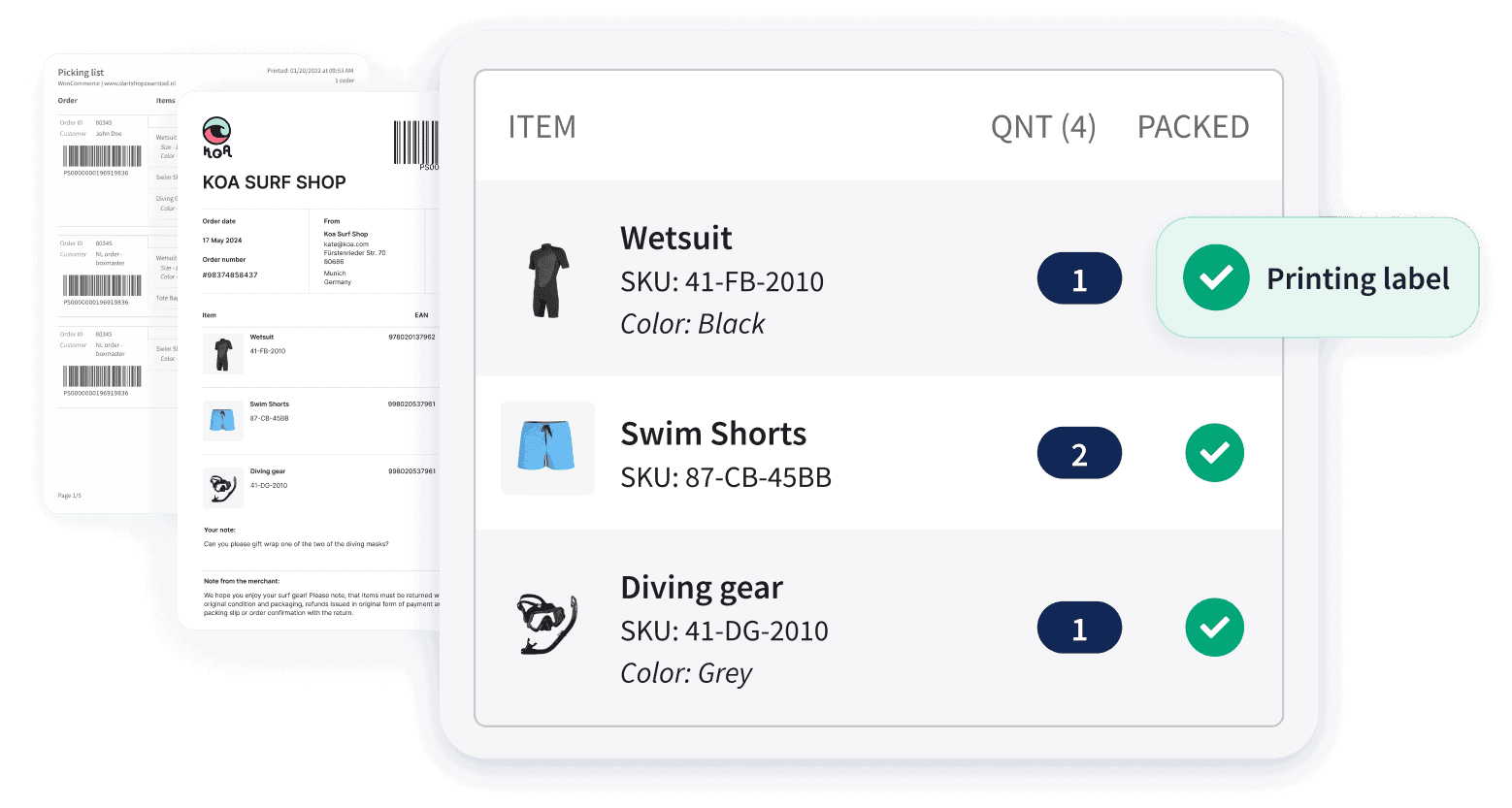
To start doing this right away, use Sendcloud - the integrated platform that lets you manage and optimize marketplace shipping and e-commerce shipping with innovative solutions. For example, integrate a multi-carrier offering or use interactive tools to create free shipping labels, find the HS code of your products, create picking lists in bulk for your warehouse picking process, and much more.
In addition, with its dedicated feature, Sendcloud gives you shipping analytics software, which, by constantly monitoring your e-commerce's performance, gives you a complete overview of the status of shipments and returns, letting you make data-driven strategic decisions. Create your free account now
How to choose the most suitable e-commerce carrier
Choosing the carrier to entrust your deliveries to is a crucial aspect of shipping successfully. According to a recent survey, 68% of online shoppers in Italy expect to receive their parcel within 3-5 days of the order date (and 13% within 1-2 days).
This means that to sell more, you have to ship better.
So, how do you choose the most suitable e-commerce carrier? Here's what to consider when choosing:
Shipping location: the first thing to evaluate is where the products are sent from. Start by analyzing your sales: how many of them are made in Italy or to foreign countries? How often? Do you prefer to keep selling abroad or focus on the Italian market to increase profit margins? In the first case, keep in mind that international shipping costs are high and you'll need to find a competitive carrier to keep your earnings intact.
Product type: if you sell special goods (for example, medical or pharmaceutical products, toxic or dangerous items, or perishable food), you'll need to find a carrier able to handle your e-commerce shipments to guarantee smooth delivery: in the case of perishable food, make sure the carrier has refrigerated vehicles to maintain the cold chain.
Returns management: if your online store handles a large volume of returns, make sure the carrier offers the service as part of the shipment via a return label. This way, the process will be much simpler and faster for customers: a great starting point for a good reverse logistics strategy.
Cash-on-delivery option: it may seem anachronistic, but in Italy cash on delivery is still used by many people. So, if you're thinking of offering it to your customers, check that the carrier includes it among the accepted payment methods.
Territorial delivery limitations: in Italy, shipping has territorial constraints, especially for sending goods to islands or remote areas (so-called hard-to-reach areas). If your customers are in these areas, check delivery availability and the extra costs involved before signing the contract with the carrier.
Want to dig deeper? Download our free guide below and instantly compare the main Italian carriers and their shipping services, comparing prices, strengths and weaknesses, and much more!
Domestic and international shipping: how to optimize them
Now that we've seen how to reduce shipping costs and choose the carrier, let's find out how to optimize domestic and international e-commerce shipments.

Domestic shipping: how to manage it effectively
Shipments made within Italy are easier to manage, but they still need to be optimized to ensure fast, on-time delivery to your customers.
For shipments within Italy, you have a wide choice of carriers and shipping options: give your customers the chance to do the same, letting them choose the option that suits them best.
While some buyers will be willing to pay extra for faster delivery, others won't be in a hurry to receive the parcel and will prefer to save on shipping. Others still will want to collect the order at a pickup point via Click & Collect.
Whatever shipping option is used, give customers the ability to track delivery in real time with personalized tracking emails and try to turn the wait into anticipation.
International shipping: how to optimize it to lower costs
Want to ship abroad your parcels? International shipping requires a series of additional measures. In this case, relying on a quality carrier is essential to guarantee on-time, uninterrupted delivery.
Before shipping, check that you comply with all the required formalities (including the commercial invoice, the customs forms, and the HS code), inform the customer of any costs they'll have to bear, and offer a realistic shipping timeframe without false promises.
Also, carefully consider the returns offering: coming from abroad, the cost of shipping returns could drastically reduce your profit margin.
Automation: the solution to optimize every shipment
We've reached the end of this guide on how to manage e-commerce shipping: we hope we've helped you understand it.
E-commerce shipping requires work, dedication, and attention to detail: like an orchestra, the perfect shipment is a set of elements playing in sync with one another.
And that's exactly why the solution to optimize every shipment comes down to automation!
Using a shipping platform like Sendcloud, you can free yourself from the manual workload, reduce data-entry errors, and manage all your logistics operations in one place to exceed customer expectations, saving time and money to devote to your business.
How does Sendcloud work? Find out in 1 minute!
What are you waiting for? Book a free demo now, or create your free Sendcloud account, connect your online store, and start shipping.
How much time can you save on shipping?

Share
Recommended for you

Shipping Intelligence
Shipping
E-commerce
Best 9 Shipping Data Analytics Software Tools (2026)
E-commerce
Enterprise
The true cost of post-purchase: what e-commerce shipping really costs enterprise retailers

VAT on shipping costs: how does it work?
Why do you pay VAT on shipping costs? Which VAT rate should you use, and how do you pass it on smartly to your customer? Find the answers in this guide.